Here are some new products made especially for all you weasel trappers out there! Hurry! Supplies are limited!
-
Join 57 other subscribers
-
Recent Posts
Archives
Categories
Contributors
Blogroll
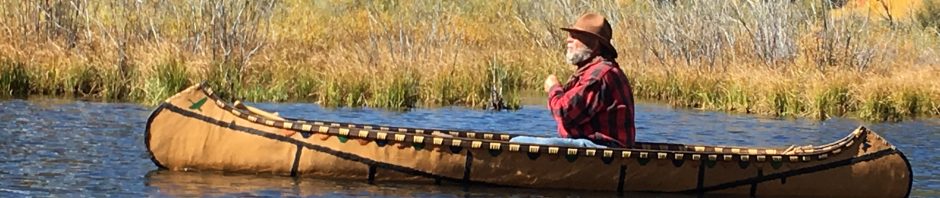
Here are some new products made especially for all you weasel trappers out there! Hurry! Supplies are limited!
I was walking in San Francisco along the Golden Gate Bridge when I saw a man about to jump off. I tried to dissuade him from committing suicide and told him simply that God loved him. A tear came to his eye.
I then asked, “Are you a Christian or a Jew or a Hindu, or what?”
He said, “I’m a Christian”
I said, “Me, too, small world, Protestant or Catholic?”
He said, “Protestant”
I said, “Me, too, what franchise?”
He said, “Northern Baptist”
I said, “Well, me, too. Northern Conservative Baptist or Northern Liberal Baptist?”
He said, “Northern Conservative Baptist”
I said, “Well, call Ripley! Northern Conservative Fundamentalist Baptist or Northern Conservative Reformed Baptist?”
He said, “Northern Conservative Fundamentalist Baptist”.
I said, “Remarkable! Northern Conservative Fundamentalist Baptist Great Lakes Region or Northern Conservative Fundamentalist Baptist Eastern Region?”
He said, ” Northern Conservative Fundamentalist Baptist Great Lakes Region”.
I said, “A miracle! ! Northern Conservative Fundamentalist Baptist Great Lakes Region of 1879 or Northern Conservative Fundamentalist Baptist Great Lakes Region of 1912?”
He said, “Northern Conservative Fundamentalist Baptist Great Lakes Region of 1912.”
I said, “Die Heretic!”
And I pushed him over!
This is an excerpt from Theodore Roosevelt’s 1893 book, The Wilderness Hunter. In this excerpt he wrote about a Sasquatch encounter near the Salmon River in Idaho.
Frontiersmen are not, as a rule, apt to be very superstitious. They lead lives too hard and practical, and have too little imagination in things spiritual and supernatural. I have heard but few ghost stories while living on the frontier, and those few were of a perfectly commonplace and conventional type. But I once listened to a goblin-story, which rather impressed me.
A grizzled, weather beaten old mountain hunter, named Bauman who, born and had passed all of his life on the Frontier, told it the story to me. He must have believed what he said, for he could hardly repress a shudder at certain points of the tale; but he was of German ancestry, and in childhood had doubtless been saturated with all kinds of ghost and goblin lore. So that many fearsome superstitions were latent in his mind; besides, he knew well the stories told by the Indian medicine men in their winter camps, of the snow-walkers, and the specters, [spirits, ghosts & apparitions] the formless evil beings that haunt the forest depths, and dog and waylay the lonely wanderer who after nightfall passes through the regions where they lurk. It may be that when overcome by the horror of the fate that befell his friend, and when oppressed by the awful dread of the unknown, he grew to attribute, both at the time and still more in remembrance, weird and elfin traits to what was merely some abnormally wicked and cunning wild beast; but whether this was so or not, no man can say.
When the event occurred, Bauman was still a young man, and was trapping with a partner among the mountains dividing the forks of the Salmon from the head of Wisdom River. Not having had much luck, he and his partner determined to go up into a particularly wild and lonely pass through which ran a small stream said to contain many beavers. The pass had an evil reputation because the year before a solitary hunter who had wandered into it was slain, seemingly by a wild beast, the half-eaten remains being afterwards found by some mining prospectors who had passed his camp only the night before. The memory of this event, however, weighted very lightly with the two trappers, who were as adventurous and hardy as others of their kind. They took their two lean mountain ponies to the foot of the pass where they left them in an open beaver meadow, the rocky timber-clad ground being from there onward impracticable for horses. They then struck out on foot through the vast, gloomy forest, and in about four hours reached a little open glade where they concluded to camp, as signs of game were plenty.
There was still an hour or two of daylight left, and after building a brush lean-to and throwing down and opening their packs, they started upstream. The country was very dense and hard to travel through, as there was much down timber, although here and there the somber woodland was broken by small glades of mountain grass. At dusk they again reached camp. The glade in which it was pitched was not many yards wide, the tall, close-set pines and firs rising round it like a wall. On one side was a little stream, beyond which rose the steep mountains slope, covered with the unbroken growth of evergreen forest. They were surprised to find that during their absence something, apparently a bear, had visited camp, and had rummaged about among their things, scattering the contents of their packs, and in sheer wantonness destroying their lean-to. The footprints of the beast were quite plain, but at first they paid no particular heed to them, busying themselves with rebuilding the lean-to, laying out their beds and stores and lighting the fire. While Bauman was making ready supper, it being already dark, his companion began to examine the tracks more closely, and soon took a brand from the fire to follow them up, where the intruder had walked along a game trail after leaving the camp. When the brand flickered out, he returned and took another, repeating his inspection of the footprints very closely. Coming back to the fire, he stood by it a minute or two, peering out into the darkness, and suddenly remarked, “Bauman, that bear has been walking on two legs.” Bauman laughed at this, but his partner insisted that he was right, and upon again examining the tracks with a torch, they certainly did seem to be made by but two paws or feet. However, it was too dark to make sure. After discussing whether the footprints could possibly be those of a human being, and coming to the conclusion that they could not be, the two men rolled up in their blankets, and went to sleep under the lean-to. At midnight Bauman was awakened by some noise, and sat up in his blankets. As he did so his nostrils were struck by a strong, wild-beast odor, and he caught the loom of a great body in the darkness at the mouth of the lean-to. Grasping his rifle, he fired at the vague, threatening shadow, but must have missed, for immediately afterwards he heard the smashing of the underwood as the thing, whatever it was, rushed off into the impenetrable blackness of the forest and the night.
After this the two men slept but little, sitting up by the rekindled fire, but they heard nothing more. In the morning they started out to look at the few traps they had set the previous evening and put out new ones. By an unspoken agreement they kept together all day, and returned to camp towards evening. On nearing it they saw, hardly to their astonishment that the lean-to had again been torn down. The visitor of the preceding day had returned, and in wanton malice had tossed about their camp kit and bedding, and destroyed the shanty. The ground was marked up by its tracks, and on leaving the camp it had gone along the soft earth by the brook. The footprints were as plain as if on snow, and, after a careful scrutiny of the trail, it certainly did seem as if, whatever the thing was, it had walked off on but two legs.
The men, thoroughly uneasy, gathered a great heap of dead logs and kept up a roaring fire throughout the night, one or the other sitting on guard most of the time. About midnight the thing came down through the forest opposite, across the brook, and stayed there on the hillside for nearly an hour. They could hear the branches crackle as it moved about, and several times it uttered a harsh, grating, long-drawn moan, a peculiarly sinister sound. Yet it did not venture near the fire. In the morning the two trappers, after discussing the strange events of the last 36 hours, decided that they would shoulder their packs and leave the valley that afternoon. They were the more ready to do this because in spite of seeing a good deal of game sign they had caught very little fur. However it was necessary first to go along the line of their traps and gather them, and this they started out to do. All the morning they kept together, picking up trap after trap, each one empty. On first leaving camp they had the disagreeable sensation of being followed. In the dense spruce thickets they occasionally heard a branch snap after they had passed; and now and then there were slight rustling noises among the small pines to one side of them.
At noon they were back within a couple of miles of camp. In the high, bright sunlight their fears seemed absurd to the two armed men, accustomed as they were, through long years of lonely wandering in the wilderness, to face every kind of danger from man, brute or element. There were still three beaver traps to collect from a little pond in a wide ravine nearby. Bauman volunteered to gather these and bring them in, while his companion went ahead to camp and made ready the packs.
On reaching the pond Bauman found three beavers in the traps, one of which had been pulled loose and carried into a beaver house. He took several hours in securing and preparing the beaver, and when he started homewards he marked, with some uneasiness, how low the sun was getting. As he hurried toward camp, under the tall trees, the silence and desolation of the forest weighted on him. His feet made no sound on the pine needles and the slanting sunrays, striking through among the straight trunks, made a gray twilight in which objects at a distance glimmered indistinctly. There was nothing to break the gloomy stillness which, when there is no breeze, always broods over these somber primeval forests. At last he came to the edge of the little glade where the camp lay and shouted as he approached it, but got no answer. The campfire had gone out, though the thin blue smoke was still curling upwards.
Near it lay the packs wrapped and arranged. At first Bauman could see nobody; nor did he receive an answer to his call. Stepping forward he again shouted, and as he did so his eye fell on the body of his friend, stretched beside the trunk of a great fallen spruce. Rushing towards it the horrified trapper found that the body was still warm, but that the neck was broken, while there were four great fang marks in the throat. The footprints of the unknown beast-creature, printed deep in the soft soil, told the whole story. The unfortunate man, having finished his packing, had sat down on the spruce log with his face to the fire, and his back to the dense woods, to wait for his companion. While thus waiting, his monstrous assailant, which must have been lurking in the woods, waiting for a chance to catch one of the adventurers unprepared, came silently up from behind, walking with long noiseless steps and seemingly still on two legs. Evidently unheard, it reached the man, and broke his neck by wrenching his head back with its fore paws, while it buried its teeth in his throat. It had not eaten the body, but apparently had romped and gamboled around it in uncouth, ferocious glee, occasionally rolling over and over it; and had then fled back into the soundless depths of the woods.
Bauman, utterly unnerved and believing that the creature with which he had to deal was something either half human or half devil, some great goblin-beast, abandoned everything but his rifle and struck off at speed down the pass, not halting until he reached the beaver meadows where the hobbled ponies were still grazing. Mounting, he rode onwards through the night, until beyond reach of pursuit.”
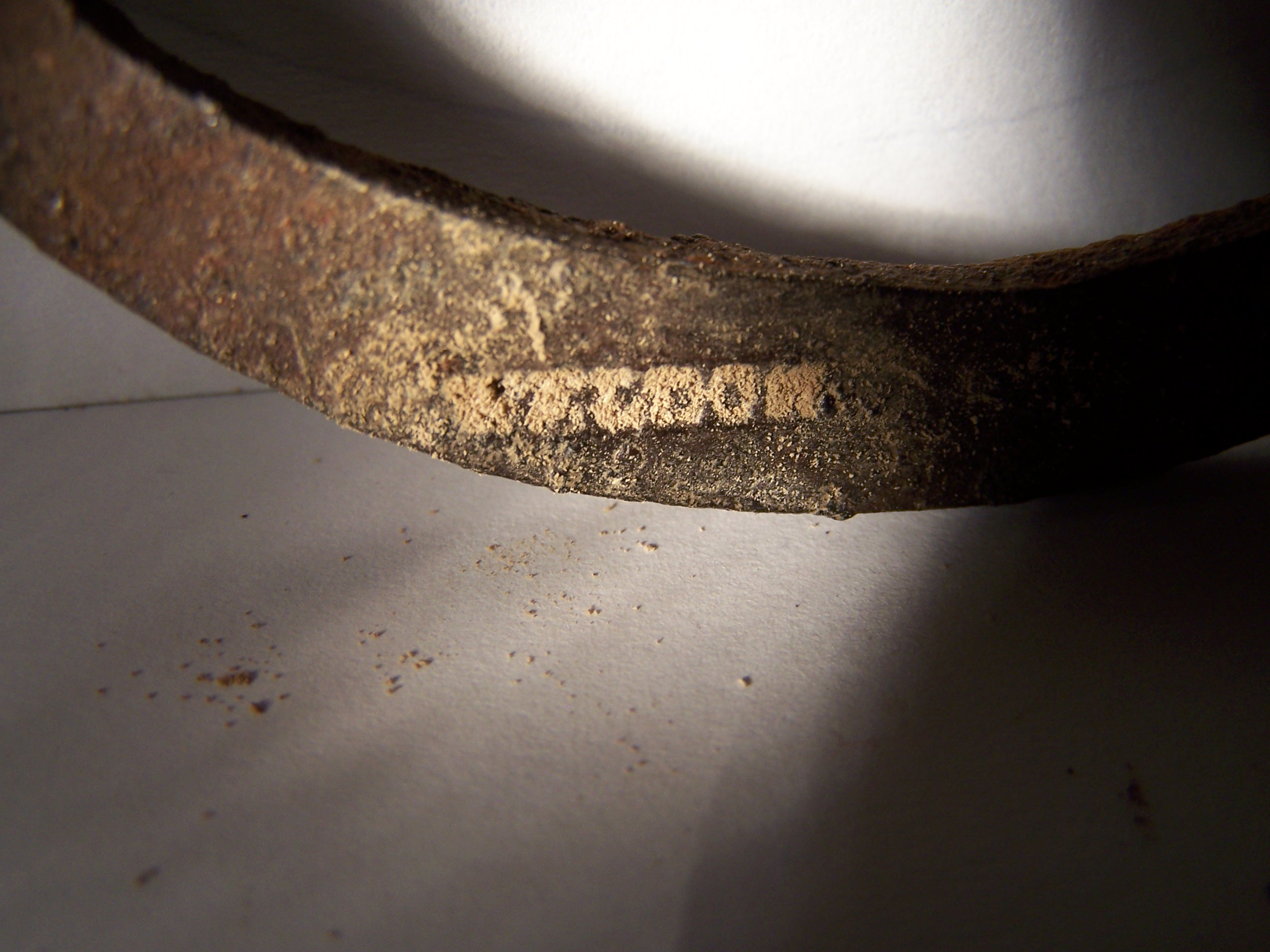
This striker was found at the same Indian campsite as my Claddagh ring. It is stamped “Weldon”. My search found a Weldon forge in Morris county, New Jersey. According to a History of Morris County, New Jersey, 1739-1882, with Illustrations and Biographical Sketches of Prominent Citizens and Pioneers; New York, W.W. Munsell & Co., 1882; Pages 39-48: “On the stream running south into Lake Hopatcong were built two forges. The upper one, called the “Welldone“–since shortened into Weldon–forge, was built by Major Moses HOPPING, probably about 1800. The land was located in 1793. The forge now belongs to Hon. William E. DODGE, of New York. The lower forge was built shortly before the other, probably in 1795, by Daniel and Joseph HURD, and called by them “New Partners.”
We believe the American Fur Company traded in the area of the Indian encampment during the early 1800’s. It is very possible these were made by Weldon forge for the American Fur Co.
I am having some of these strikers reproduced. Note the unique shape of this striker. Not exactly oval, but mostly so.

Here is a close up of the name:
I hope to have these by summer of this year. If you are interested in owning a documented piece of Fur Trade history let me know.
I wear a silver ring at Rendevous. It is of ancient Irish design and it is a replica of a North American fur trade artifact. My ring looks like this:

An original symbol of the “Fisher Kings” of the Galway town of Claddagh, Ireland, (pronounced clada) the design was first fashioned into the traditional ring back in the 17th Century during the reign of Mary II.
Legend has it that a young Irishman, Richard Joyce, bound for the West Indian slave plantations – no doubt the Irish Caribbean island of Montserrat – was kidnapped in rough seas by a band of Mediterranean pirates and sold to a Moorish goldsmith who over the many long years of his exile helped him perfect the skills of a master craftsman.
When in 1689 King William III negotiated the return of the slaves, Joyce returned to Galway – despite, it’s said, the Moor’s offer of his daughter’s hand in marriage and a princely dowry of half of all his wealth.
Back in Ireland, a young woman had never stopped faithfully waiting for her true love to return. Upon which time he presented her with the now famous Royal Claddagh gold ring – a symbol of their enduring love. Two hands to represent their friendship, the crown to signify their loyalty and lasting fidelity, and the sign of the heart to symbolize their eternal love for each other. It is widely known as a symbol for great friendship. This ancient Gaelic design is also used in engagement rings and in traditional wedding rings for the Irish. If worn on the right hand with the heart facing out it means you are single, facing in means you are dating someone. If worn on the left hand with the heart facing out it means you are engaged and facing in you are married.
A ring just like mine was found at an ancient Indian campsite along the Minnesota/Canadian border. This campsite was probably used as a seasonal camp for fishing and trading with the Hudson’s Bay Company post nearby.

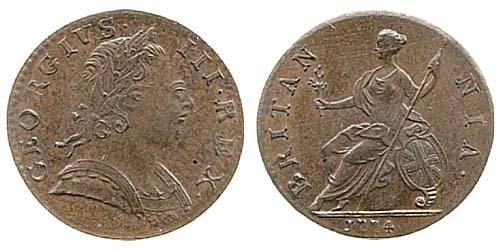
You can clearly see the heart and hands of the Claddagh symbol. The crown has been broken off and lost. From the same site was found a British coin, it is dated in the 1770’s. This confirms the time frame and the presence of British traders.
Hence, I have a very nice piece of Irish jewelry that was available here in the North American fur trade.
In his painting entitled “Walker and wife”, Alfred Jacob Miller depicts a set of saddle holsters with bear hide flaps over the pommel of Joseph R. Walker’s saddle. The following photos depict my re-creation of these holsters. A special “Thank you” goes to my good friend, Ron Parks for giving me the bear hide.

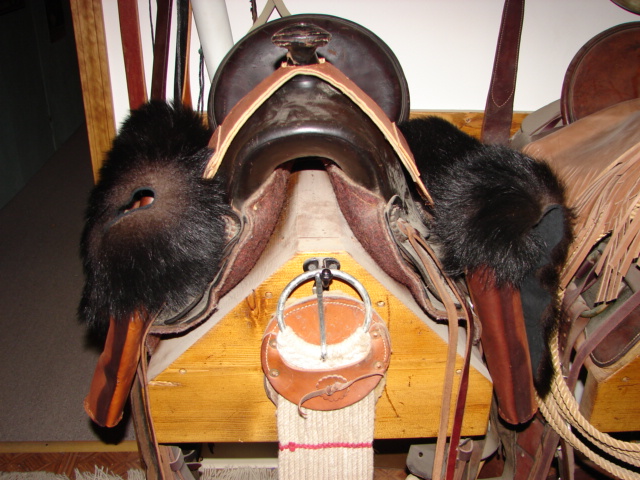
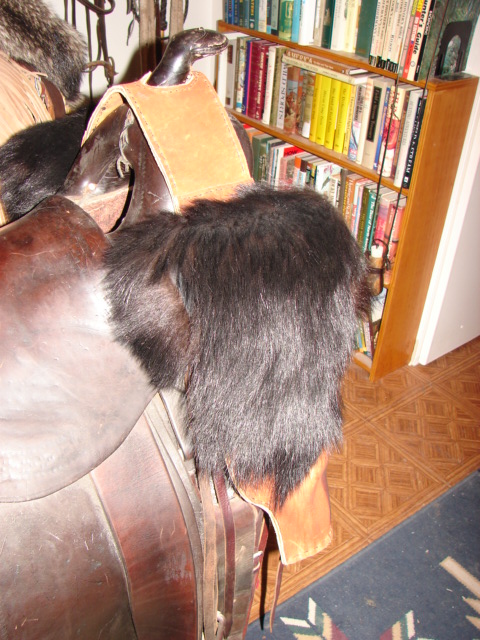

I still need to put the tie downs on the flaps and give the leather a complete coat of oil. These will make a great prop in my camp as well as good travel cases for my pistols to and from rendezvous.
I won’t be wronged, I won’t be insulted and I won’t be laid a hand on. I don’t do these things to other people and I require the same from them. John Bernard Books, 1901
This is a quick, easy way to clean a muzzle loader. The key is, allow your cleaning solution to work.
The solution I like best is a homemade formula. Mix together:
4 ounces of hydrogen peroxide
4 ounces of 91% rubbing alcohol
4 ounces of Murphy’s Oil Soap
Note– Because of the peroxide you will need to keep the solution in dark bottles.
If you are cleaning a caplock put a piece of leather or rubber over the nipple and ease the hammer forward to hold the leather or rubber in place over the nipple. Do not drop the hammer because it will put a small piece of leather into your nipple just the same as a leather punch cuts a small piece out to make a hole. Flintlock shooters should remove the lock from their gun and then use a toothpick or whittled matchstick to seal the touchhole. I then put about 2 ounces of cleaning solution down the barrel. (This amount will fill the average pistol barrel.) Prop the gun up in a secure place where it won’t get knocked over, and allow it to sit for 5 to 10 minutes. (I use this time to clean the lock of my flinter. A wood handled tooth-brush and a small amount of solvent removes the built up fouling in no time.)
Then pour the solution out, and run two solution soaked patches down the barrel. Follow that with a couple clean dry patches. If the dry patches comes out dirty, run another soaked patch followed by a dry patch. You should be about there on the second one. If you need to, repeat the soaked patch followed by a dry patch a third time. If the gun is not clean after the third try, plug the nipple or touchhole again and re-soak the barrel. (I have been cleaning my muzzleloaders this way for over 3 years now, and only a couple of times have I had to re-soak a barrel.) On my caplocks, I will now remove the lock, nipple and clean-out screw and take a solution soaked patch to the lock, mortise and exterior barrel, while the nipple and screw soak in a little solution. After drying the barrel, I like to stand my weapon muzzle down for a few minutes to let any trapped solution run out of the breach and down the barrel. A few minutes later, still holding the gun muzzle down, I’ll wipe the bore with another dry patch to soak up anything that has drained out of the breech. Before installing the nipple and screw, I take a dry cotton swab and clean out the threads and channels. Sometimes I have to remove most of the cotton to get into the passage ways. Then I put a small drop of oil on the threads of the nipple and screw before I install them.
I follow the dry patches in the bore with a lightly oiled patch and after cleaning I give the entire gun a light coat of oil. I use an oil called Ballistol. It is biodegradable and slightly acidic to counter the causticness of corrosive primers and black powder.
When using this solution to clean your gun, it is very important to get a good coat of light oil on the piece as soon as possible after cleaning. The hydrogen peroxide and the alcohol have some water in the solutions, but the alcohol in the solution allows it to dry rapidly.
There is no shame in being poor.
The only shame is in not trying to get rich.
Pericles
 Gabe the Shootist
 Gabe the Shootist